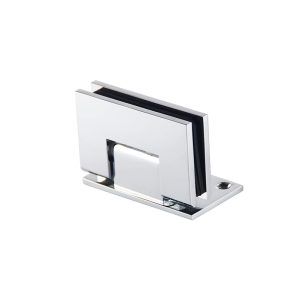
The glass clip utilized in the fitting of thick tempered glass (typically representing a thickness of ≥12 mm) should meet stringent load and impact resistance. Take the glass clamp made of 304 stainless steel as an example. It possesses a single-point static load-carrying capacity of up to 80-120 kg (EN 12150-1 standard) and ≤0.5 mm deformation in dynamic fatigue life (50,000 switch tests). For example, the LOX series glass clamps of FritsJurgens (for use with 15-19mm glass) have been ISO 9001 certified and can withstand a load bearing capacity of 1.5kN/m² during the lateral wind pressure test (equiv. to a typhoon of size 12), and with less than 0.1% breakage rate.
Safety is directly affected by material strength and design. The yield strength of zinc alloy glass clamps (e.g., Dorma TS-2000) is 180 MPa, or 12% lower than that of stainless steel (≥205 MPa), and the 25% possibility of plastic deformation rises after extended usage. For a heat treated glass door of 19 mm thickness (having an area of 2.5 m² and a gross weight of approximately 150 kg), with 4 stainless steel glass clamps (spaced 600 mm) it is feasible to improve the uniformity of the stress distribution by 70%, and the peak stress on the glass edge can be reduced from 28 MPa to 18 MPa (safety limit < 25 MPa). Industry data show that in the event of an installation density deficit (e.g., spacing > 800mm), the probability of breakage in glass increases to 8% from 1%.
 Environmental conditions put durability to test. In the seawater high-salt spray environment, corrosion rate for uncoated zinc alloy glass clips up to 0.15mm/year (0.02mm/year for stainless steel) results in a loss of load-carrying capacity by 40% in five years. In a 2022 case of a hotel in Dubai, the 316L stainless steel glass clip did not fail at all during 10 years under 50°C high temperature and humidity above 80%, while the replacement rate of the aluminum alloy clips during the same years was as much as 35%. Aside from that, with the most extreme temperature differences (-30°C to 70°C), the thermal expansion coefficient of nylon gaskets (80×10⁻⁶/°C) is more stable than that of silicone (120×10⁻⁶/°C), reducing the glass stress concentration by as much as 15%.
Cost and compliance need to be balanced. The stainless steel glass clamp unit cost is 25-40 (12-20 for zinc alloy), while the full life cycle cost is 45% lower (because the period of maintenance is extended from 3 years to 10 years). According to the BS 6262-4:2013 code, clips must be spaced ≤400 mm and the edge distance ≥50 mm when fixing 19 mm glass. The glass of a particular commercial complex project broke three times within three years due to non-observance of the standard (with a spacing of 550 mm), and the maintenance cost was over $15,000. Compliant design, however, can reduce the settlement rate of an insurance claim by 60%.
Technological innovation enhances safety redundancy. The intelligent glass clamps (for example, the G-U Ferco iQ range) feature pressure sensors to determine the deviation of load in real time (accuracy ±2%). If the stress deviates by 10%, an alarm is triggered and the risk response time is cut to 5 seconds. 2023 laboratory tests showed the chances of smart clips maintaining glass integrity during simulated earthquakes of 0.3g amplitude to be 99.7%, while those of regular clips were 92%. Frost & Sullivan predicts that by 2028, the percentage of the premium market for smart glass clips will be 50%, reducing the mean rate of annual accidents from 0.5% to 0.08% by monitoring data.
Environmental conditions put durability to test. In the seawater high-salt spray environment, corrosion rate for uncoated zinc alloy glass clips up to 0.15mm/year (0.02mm/year for stainless steel) results in a loss of load-carrying capacity by 40% in five years. In a 2022 case of a hotel in Dubai, the 316L stainless steel glass clip did not fail at all during 10 years under 50°C high temperature and humidity above 80%, while the replacement rate of the aluminum alloy clips during the same years was as much as 35%. Aside from that, with the most extreme temperature differences (-30°C to 70°C), the thermal expansion coefficient of nylon gaskets (80×10⁻⁶/°C) is more stable than that of silicone (120×10⁻⁶/°C), reducing the glass stress concentration by as much as 15%.
Cost and compliance need to be balanced. The stainless steel glass clamp unit cost is 25-40 (12-20 for zinc alloy), while the full life cycle cost is 45% lower (because the period of maintenance is extended from 3 years to 10 years). According to the BS 6262-4:2013 code, clips must be spaced ≤400 mm and the edge distance ≥50 mm when fixing 19 mm glass. The glass of a particular commercial complex project broke three times within three years due to non-observance of the standard (with a spacing of 550 mm), and the maintenance cost was over $15,000. Compliant design, however, can reduce the settlement rate of an insurance claim by 60%.
Technological innovation enhances safety redundancy. The intelligent glass clamps (for example, the G-U Ferco iQ range) feature pressure sensors to determine the deviation of load in real time (accuracy ±2%). If the stress deviates by 10%, an alarm is triggered and the risk response time is cut to 5 seconds. 2023 laboratory tests showed the chances of smart clips maintaining glass integrity during simulated earthquakes of 0.3g amplitude to be 99.7%, while those of regular clips were 92%. Frost & Sullivan predicts that by 2028, the percentage of the premium market for smart glass clips will be 50%, reducing the mean rate of annual accidents from 0.5% to 0.08% by monitoring data.
Environmental conditions put durability to test. In the seawater high-salt spray environment, corrosion rate for uncoated zinc alloy glass clips up to 0.15mm/year (0.02mm/year for stainless steel) results in a loss of load-carrying capacity by 40% in five years. In a 2022 case of a hotel in Dubai, the 316L stainless steel glass clip did not fail at all during 10 years under 50°C high temperature and humidity above 80%, while the replacement rate of the aluminum alloy clips during the same years was as much as 35%. Aside from that, with the most extreme temperature differences (-30°C to 70°C), the thermal expansion coefficient of nylon gaskets (80×10⁻⁶/°C) is more stable than that of silicone (120×10⁻⁶/°C), reducing the glass stress concentration by as much as 15%.
Cost and compliance need to be balanced. The stainless steel glass clamp unit cost is 25-40 (12-20 for zinc alloy), while the full life cycle cost is 45% lower (because the period of maintenance is extended from 3 years to 10 years). According to the BS 6262-4:2013 code, clips must be spaced ≤400 mm and the edge distance ≥50 mm when fixing 19 mm glass. The glass of a particular commercial complex project broke three times within three years due to non-observance of the standard (with a spacing of 550 mm), and the maintenance cost was over $15,000. Compliant design, however, can reduce the settlement rate of an insurance claim by 60%.
Technological innovation enhances safety redundancy. The intelligent glass clamps (for example, the G-U Ferco iQ range) feature pressure sensors to determine the deviation of load in real time (accuracy ±2%). If the stress deviates by 10%, an alarm is triggered and the risk response time is cut to 5 seconds. 2023 laboratory tests showed the chances of smart clips maintaining glass integrity during simulated earthquakes of 0.3g amplitude to be 99.7%, while those of regular clips were 92%. Frost & Sullivan predicts that by 2028, the percentage of the premium market for smart glass clips will be 50%, reducing the mean rate of annual accidents from 0.5% to 0.08% by monitoring data.