Brewery Spare Parts and Maintenance Planning
A brewery stops for a gasket far more often than it stops for a kettle. HGMC publishes spare parts supply and maintenance support as part of its service list, alongside installation, commissioning and operator training, and covers tank accessories and electronic components with a 6-year warranty against manufacturing defects from the factory, used within scope. The practical job for a brewery is deciding which small items must sit on a shelf today and which can wait for a delivery.

Key takeaways
- HGMC publishes spare parts supply and maintenance support as services, with sales and engineers online 24 hours.
- Warranty wording: 6 years on tank accessories and electronic components against manufacturing defects from the factory, used within scope.
- Wear items such as seals, gaskets and valve seats are maintenance matters rather than defect claims.
- Published lead time for new equipment is 90–150 days from deposit to door delivery, which is why some spares are worth holding.
The items that actually stop a brew
The failures that cost production time are rarely structural. They are the soft parts of the plant: manway and hop-port gaskets, tri-clamp seals, valve seats and diaphragms, pump mechanical seals and O-rings, sight glass seals, hoses, clamps, and the small electrical items such as temperature sensors and pressure switches. None of them is expensive. All of them can stop a brew day at the moment a tank is full and a valve will not seal.
Sort them by two questions: how often does it fail, and how long does it take to arrive. A gasket that fails twice a year and can be couriered overnight needs no stock beyond the current spare. A custom-moulded seal on a vessel manway, or a matched set for a specific valve, can take far longer to source, and that is the box worth keeping on the shelf.
What the published service cover includes
HGMC publishes its services as equipment installation, commissioning, operator training, maintenance support and spare parts supply, with a service team for technical support and 24/7 sales availability. Sales staff and engineers keep 24 hours online, which matters most at the start, when a new brewery is still learning which noise is normal and which one needs a phone call.
The same service list is the right frame for a maintenance plan. The published hgmc craft beer equipment line runs from brewery systems and fermentation tanks to filling machines, CIP and CO2 recovery plants, and the service list is published for those vessels rather than for the equipment alone. Installation and commissioning set the baseline, training turns it into daily practice, maintenance support covers the scheduled work, and spare parts supply covers the unplanned. A brewery that writes all five into its own maintenance calendar has a plan rather than a hope.
Warranty, wear and the difference between them
The published warranty is 6 years on tank accessories and electronic components against manufacturing defects from the factory, provided they are used within scope. That is a defect cover, not a consumables budget: a gasket compressed a thousand times, or a seal run past the point where the pump started leaking, is wear rather than a manufacturing fault.
Keeping the two categories separate saves arguments in both directions. Record the serial number and the date a part was fitted, note whether a failure followed unusual service, and the conversation with a supplier starts from facts. It is the same discipline as the tank data plate: a maker who stamps a pressure-test record and serial number on a vessel is a maker who expects parts to be traceable.
Building a spares shelf sized to the brewery
Start from the vessel list rather than from a generic kit. Count the gaskets on every manway, the seals on every valve, the mechanical seals on every pump running hot wort, and the sensors the control panel depends on. Then decide which of those items appear more than twice a year and hold one or two of each.
Two more habits are worth building in. First, log every part changed against the date and the reason, so the second failure of the same item becomes a scheduled replacement instead of a surprise. Second, keep the consumable items in one cabinet with the part numbers facing out, because a spares shelf nobody can find has the same value as no spares shelf at all.
Published cover and what to plan for it
| Published item | What the site states | Brewery planning task |
|---|---|---|
| Spare parts supply | Listed as one of the published services | List the part numbers for soft items and hold the slow-shipping ones |
| Maintenance support | Published alongside installation and commissioning | Set a service calendar from commissioning day onwards |
| Operator training | Published as part of the service list | Train a second person on every routine task before the busy season |
| Warranty cover | 6 years on tank accessories and electronic components against manufacturing defects from the factory, used within scope | Keep the serial numbers and fitting dates for anything electronic |
| Technical support | Sales and engineers keep 24 hours online; 24/7 sales availability | Store the contact route where the night shift can find it |
Worked example: sizing a spares budget
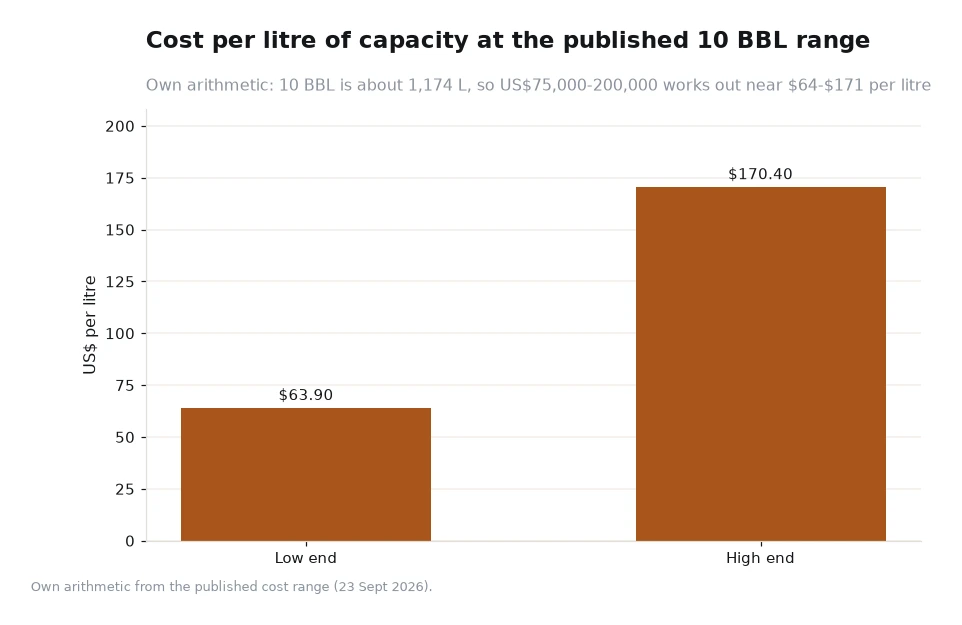
Take the published cost example for a complete 10 BBL system, around US$75,000–200,000, and use a spares allowance expressed as a percentage of the equipment value rather than as a guess. At 2% of the low end, the annual allowance is US$75,000 × 0.02 = US$1,500. At 2% of the high end it is US$200,000 × 0.02 = US$4,000.
Now hold the same percentage across the range instead of the two ends: a brewery that allows 2% of a US$120,000 order would set aside US$120,000 × 0.02 = US$2,400 a year, which is US$200 a month. Spread over a year that is roughly the price of replacing a handful of seals and gaskets several times over with a spare of each held in stock. If the brewery runs two shifts and packages daily, lifting the allowance to 3% on the same order gives US$120,000 × 0.03 = US$3,600, or US$300 a month. The percentages are our own example and the only priced figure is the published 10 BBL range, but the exercise is worth doing before the first seal fails rather than afterwards.
Frequently asked questions
Are consumable parts covered by the warranty?
No. The published cover is 6 years on tank accessories and electronic components against manufacturing defects from the factory, used within scope. Parts worn out in normal service are a maintenance item.
How quickly can spare parts be supplied?
HGMC publishes spare parts supply as a service and keeps sales and engineers online 24 hours, with 24/7 sales availability. Delivery time for a specific part should be confirmed with the service team at the time of the enquiry.
Write the maintenance plan before the tanks arrive
Build the spares list from the vessel and valve schedule while the order is still in fabrication, and ask which items the factory recommends holding in stock for your configuration. The answer is usually shorter than the list a brewery would write from a catalogue, and it is specific to the plant you actually bought.
Then keep the plan small enough to survive a busy month, and review it once a season using the maintenance log. A brewery that replaces soft parts on schedule spends its money on beer rather than on emergency freight. The beer brewing equipment range is where the vessel list starts, the brewhouse equipment pages cover the hot side, and the turnkey brewery plant section shows how the services are bundled with a complete order.
Service items, warranty wording and the 10 BBL cost range quoted above come from the manufacturer's own website, read 23 Sept 2026, and the spares percentage arithmetic is our own example with its assumptions stated in the text.[1] Confirm recommended spares and lead times with the service team for your own vessel list.