A gift or travel set rarely has one minimum order quantity. It has several — glass, closure, decoration, gift box, carton and fragrance concentrate — and the tallest of them becomes the number you are quoted. The practical move is to find out which component is setting that floor before you ask for a price, because that is the only component genuinely worth negotiating.
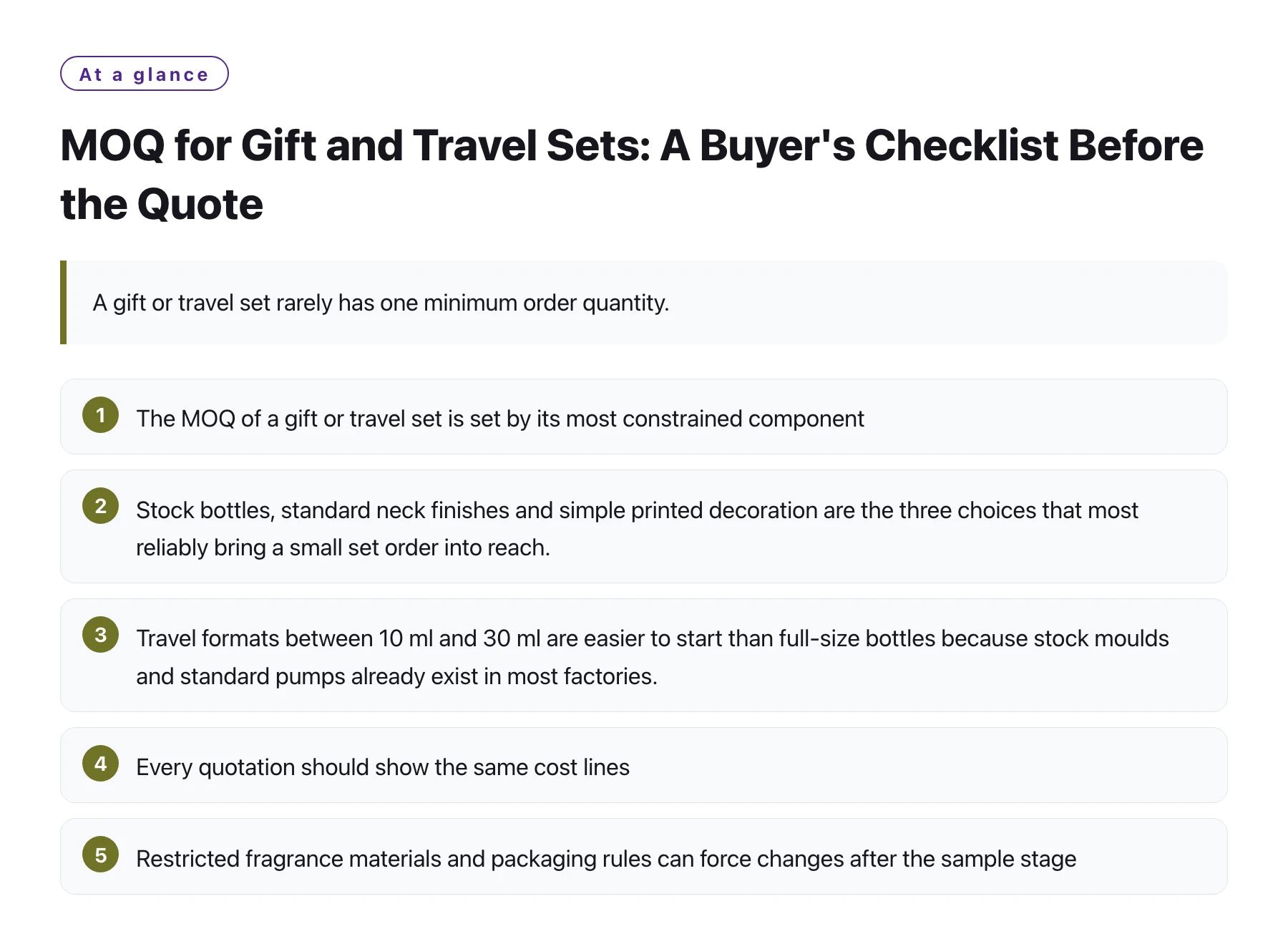
Key takeawaysThe MOQ of a gift or travel set is set by its most constrained component, which is usually a custom bottle mould or a custom gift box rather than the juice. · Stock bottles, standard neck finishes and simple printed decoration are the three choices that most reliably bring a small set order into reach. · Travel formats between 10 ml and 30 ml are easier to start than full-size bottles because stock moulds and standard pumps already exist in most factories. · Every quotation should show the same cost lines; a single unit price with no breakdown cannot be compared with a competitor's and cannot be renegotiated later. · Restricted fragrance materials and packaging rules can force changes after the sample stage, so the specification deserves a check before the order quantity is fixed.
Most buyers approach a set project from the wrong end. They have a retail price in mind, they ask for a quotation, and they receive a number that reflects decisions nobody has actually made yet: which bottle, which box, which finish, which concentrate batch.
A set multiplies those decisions. A single bottle has one MOQ; a set has one for the glass, one for the cap and pump, one for the decoration run, one for the rigid box and its insert, one for the carton, and one for the fragrance concentrate. The order quantity is the highest of those floors, not the average.
What follows is a checklist for working through them in the right order.
Finding the component that sets your floor
Start by listing every component in the set and marking which ones already exist in a manufacturer's standard range. A stock 30 ml glass bottle, a standard crimp pump and a printed folding carton carry no tooling cost and almost no minimum beyond the filling run. A bespoke bottle with a magnetic cap and a rigid box with a die-cut insert carries tooling for each of those parts.
The arithmetic that matters is that the smallest number in the list is not the answer; the largest is. Buyers who negotiate the fragrance volume first often discover afterwards that the gift box alone requires three times the quantity they had planned.
Glass and closures
Glass is the least flexible part of a small order. A new mould has to be cut, and the mould shop will require a minimum run to make that worthwhile, so the practical question is whether an existing shape can carry the design. Standard neck finishes matter for the same reason: a pump or cap that fits a stocked neck needs no tool, while a bespoke cap does. A manufacturer that runs custom fragrance R&D and production under one roof can usually answer this in a single call, because the person quoting knows what is already on the shelf.
Decoration
Screen printing, hot stamping, spray coating, metallising and laser etching do not share a minimum. Printing and labelling tolerate short runs best; coating and metallising are set-up heavy and become economical only at higher volumes. If the first order is small, a printed label on a stock bottle is not a compromise in quality — it is a way to keep the launch affordable while the scent is proven in the market.
The box, the insert and the carton
Rigid gift boxes are assembled by hand, and the die and the assembly jig are both tooling items. An insert that holds three travel sprays is another die. A workable first run often uses a stocked box format with a printed wrap and a simple pulp or EVA insert, and reserves the fully bespoke construction for a second order once the volumes are known.
The five numbers behind a single quoted MOQ
| MOQ driver | What sets the floor | How to move it |
|---|---|---|
| Glass bottle | A new mould requires a minimum run; stock moulds do not | Choose an existing shape, or use stock glass and differentiate with decoration |
| Cap and pump | Bespoke caps need tooling; standard neck finishes do not | Match the neck to a stocked finish and print or metallise a standard cap |
| Decoration | Set-up time per run for printing, stamping or coating | Use a label or a simple print on the first order and move to coating later |
| Gift box and insert | Die-cut, assembly jig and hand assembly time | Start from a stocked box format with a printed wrap and a simple insert |
| Concentrate | The smallest batch a perfumer will compound, plus any restricted materials | Share one concentrate across two or three SKUs in the same launch |
The largest number in that middle column is your order quantity. Everything below it can be scaled to match.
What to settle in writing before you compare prices
A set quotation is only comparable if both suppliers are quoting the same pack. Send an identical brief: bottle reference or dimensions, fill volume, decoration method, box construction, insert, carton, labelling, and the number of SKUs in the set. The set-specific version of the general list of the questions to ask a perfume factory is really the same discipline with more components attached.
Agree how units are counted
Some suppliers quote per set, some per bottle, and some per inner pack of six sets. Confirm whether the MOQ applies to finished sets or to each component, and whether a mixed set — one full bottle plus a travel spray, for example — counts as one unit or two.
Fix a physical reference sample
Seal an approved sample with the date, batch and formula reference and keep a copy on both sides. Photographs and memory are not references, and most decoration disputes are really disagreements about which version was approved.
Ask what the price excludes
Mould and tooling cost, artwork separations, testing, freight, duty and the deposit schedule are frequently outside the unit price. Ask for them as separate lines, because they behave differently: tooling is paid once and belongs to whoever paid for it, while testing and freight recur with every order. Ask too who holds the mould if the relationship ends.
Do not accept a quotation that gives one MOQ without telling you which component produces it. If the number is driven by a custom box, the fix may be a smaller change than you expect; if it is driven by the concentrate, the conversation is about sharing a base across the range. Either way, you cannot choose the cheaper path until you know which one you are on.
Comparing two suppliers at different volumes
Ask each supplier for two prices: one at the MOQ and one at roughly three times the MOQ. The shape of that curve tells you more than either number on its own. A supplier whose price barely moves is telling you that fixed costs dominate — tooling, set-up, artwork — which means a larger first order buys less than you would hope.
Then ask how the price changes if one component moves to stock. That isolates the cost of differentiation and helps you decide whether a bespoke bottle is worth the premium on a first travel set, or whether the money is better spent on the scent and the box printing.
Compliance belongs in the same conversation. Fragrance materials are regulated by product category and concentration, and a formula that works for a body lotion may need reformulating for a leave-on fine fragrance [1]. Packaging is regulated too: rules on packaging and packaging waste in the EU set design and recyclability expectations for packaging placed on that market, which can rule out some mixed-material set formats [2].
None of this changes the MOQ by itself, but a change that arrives after tooling has been cut costs far more than one caught before. Some manufacturers, including the one behind the Xuelei official site, publish their service scope and certification list, which at least gives a buyer something concrete to check a claim against at this stage.
Sources
- IFRA Standards Library (International Fragrance Association) —— The IFRA Standards Library lists the restrictions the fragrance industry applies to individual fragrance ingredients, based on safety assessments; it is the reference point for compliant fragrance formulation.
- European Commission: Packaging Waste and the PPWR —— EU rules on packaging and packaging waste, including the Packaging and Packaging Waste Regulation requirements on recyclability and design.
Frequently asked questions
Is the MOQ based on finished sets or on each component?
Usually on each component, with the finished-set quantity then set by the highest component minimum. Ask the supplier to state both numbers explicitly, because a quotation that lists only finished sets hides which part is driving the volume.
Can I mix two scents inside one gift set?
Yes, and it is common. The effect on the MOQ depends on whether both scents come from the same concentrate batch and whether the bottles and caps are shared. Two scents in identical bottles usually add very little; two scents with different bottle formats add a second set of tooling.
What is a realistic first order for a travel spray set?
It depends entirely on the components. With stock glass, a standard pump and printed cartons, a first run can be modest. With a bespoke bottle, a magnetic cap and a rigid box with a custom insert, the tooling minimums dominate and the first order is measured in thousands of sets rather than hundreds.
Should the tooling be paid for separately?
It is clearer if it is. A separate tooling line tells you what you are buying, lets you confirm who owns the mould, and prevents the cost being buried in a unit price that looks competitive only because the tooling was amortised over an unrealistic volume.
How long does it take to get an accurate set quotation?
An accurate one requires a defined pack, so the answer depends on how quickly you can specify bottle, decoration, box and concentrate. Once those are fixed, a written quotation with the cost lines separated usually arrives within a few working days.