A factory-direct seller and a trading company can each fit a sourcing project. The useful comparison identifies who contracts, manufactures, coordinates, verifies, and resolves problems, then prices the complete scope against the same requirements.
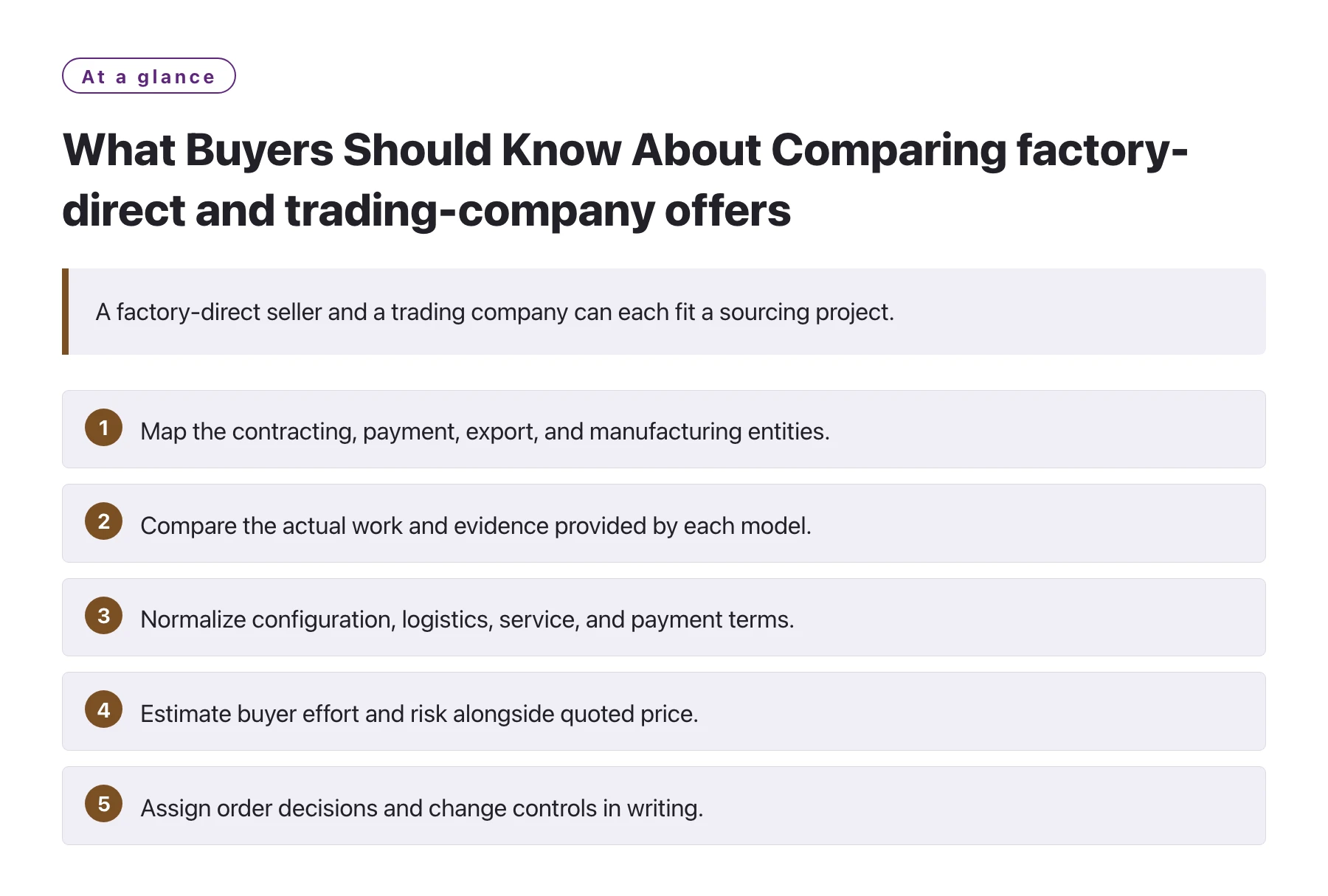
Key takeawaysMap the contracting, payment, export, and manufacturing entities. · Compare the actual work and evidence provided by each model. · Normalize configuration, logistics, service, and payment terms. · Estimate buyer effort and risk alongside quoted price. · Assign order decisions and change controls in writing.
Business labels alone do not reveal accountability. Trace the parties and responsibilities behind each offer before selecting a supplier model.
1. Map the parties behind each offer
“Factory direct” and “trading company” describe possible business roles, not a complete risk rating. A factory may sell through an export affiliate, while a trading company may coordinate several production sites. Begin by mapping who contracts, invoices, receives payment, owns or operates the facility, manufactures the goods, and handles export documentation.
Request legal names and addresses for each relevant party and explain any difference between seller and producer. Identify who is responsible for the product specification, quality release, delivery commitment, warranty, and corrective action. Put the answer in the quotation record so an attractive label does not replace a clear accountability map.
2. Verify identity and payment path
The U.S. Department of Commerce recommends due diligence when evaluating foreign business partners. Verify the contracting entity, authorized contacts, beneficiary details, and important claims through proportionate independent checks. If payment is requested to an unrelated person or company, pause and establish the legal and commercial relationship before remitting funds. [1]
Use a previously verified channel to confirm any new bank details or urgent change. Keep registration records, invoice identity, and approval history with the order. These checks reduce avoidable ambiguity but do not prove manufacturing capability, product conformity, or future financial performance.
3. Compare the actual service and production scope
Ask what the factory-direct supplier performs itself: product engineering, sourcing inputs, assembly, testing, packing, export coordination, and after-sales service. Ask the trading company which factories and subcontractors it would use and what coordination or verification work it adds. Request process maps and responsibility boundaries rather than relying on a sales description.
A trading company may simplify multi-category coordination or combine supplier communication, while a direct factory may offer closer technical access for its own product. Either model can fit a project. Compare the tasks, expertise, visibility, and accountability offered for the exact order, not the business type alone.
4. Normalize quotations line by line
Compare configuration, quantity breaks, minimum order, tooling, samples, packaging, inspection, inland transport, export handling, delivery basis, warranty, and payment terms. Ask for supplier price and service charges separately where possible. A trading offer may include coordination or combine several items; a factory offer may exclude export or project support.
Record quote date, revision, currency, validity, assumed volume, lead time, and exclusions. Keep alternate specifications separate from compliant offers. If the two prices differ, identify whether the cause is scope, material, quality evidence, commercial margin, volume, or a different delivery assumption before deciding which is lower.
5. Inspect evidence and traceability
Ask for product-specific evidence tied to a named factory and configuration: drawings, bills of material, test records, sample history, process checks, and corrective actions as appropriate. For an intermediary, ask how documents are obtained, reviewed, and linked to the producer. For a factory, check whether records cover the actual line and variant proposed for the buyer.
Distinguish independent observation from supplier statements and brokered documents. If a trading company supplies a certificate or report, verify its issuer and scope. If a factory provides a self-declaration, determine what it supports and what independent review remains necessary. Neither direct access nor a document packet automatically resolves every technical question.
6. Assess communication and problem resolution
Test how each bidder handles a real clarification: who answers engineering questions, who coordinates revisions, who escalates a failed sample, and who can approve a change. Name the operating contact and alternate. Agree working hours, update cadence, language, response expectations, and the record that confirms a decision.
Ask for a realistic example of a late material change or inspection finding. A trading company may act as a central coordinator, but confirm how quickly the factory receives and acknowledges a change. A direct factory relationship may shorten technical paths, but the buyer still needs a clear commercial and escalation contact.
7. Consider product breadth and order complexity
A single specialized item may benefit from a direct technical relationship, while a mixed order with several product families can require coordination across multiple plants. Compare the number of parties, shared packing plan, consolidated shipment needs, and schedule dependencies. Ask who owns integration problems when one category is late or incompatible with another.
For a repeat item, evaluate change control, spare parts, continuity, and access to production records. For a one-time or customized order, prioritize project management, sample handling, and defined responsibilities. Do not assume one model is always more transparent; ask what information and access will actually be provided.
8. Calculate total cost and exposure
Estimate total landed and operational cost, not only the quoted unit price. Include quality verification, inspection, travel, export packing, freight assumptions, coordination effort, communication delays, and the buyer’s own time. Note who pays for sample rounds, supplier visits, rework, replacement, and any outside testing.
Review payment milestones, deposits, cancellation rights, warranty process, and dispute route. A lower offer may transfer more work and uncertainty to the buyer. A higher offer may be justified if its service is defined, evidenced, and valuable; otherwise request a revised breakdown rather than paying for a vague promise.
9. Select a control model that fits the risk
Use mandatory gates for identity, technical fit, required evidence, and market compliance. Then compare service quality, transparency, schedule, total cost, and flexibility. Identify where independent inspection, direct factory access, contract terms, or a pilot order would reduce a material uncertainty. Keep selection criteria consistent across bidders.
Write down which controls belong to the supplier, intermediary, buyer, and third-party reviewer. For example, a trading company may coordinate factory communication, while the buyer approves specifications and an independent inspector records shipment findings. Named owners make it easier to close a gap without assuming that another party has handled it.
10. Document the final arrangement
Before award, reconcile the accepted quotation with the parties map, factory identity, approved product revision, service scope, delivery responsibilities, payment terms, and warranty route. Attach approved documents and define how supplier substitutions or new subcontractors will be reviewed. Confirm whether the seller or manufacturer is liable for each obligation.
Teams comparing sourcing manufacturers in China can use a responsibility matrix to evaluate direct and intermediary offers on evidence, workload, and accountability. Confirm the selected party’s current terms directly and retain buyer approval over technical, commercial, and compliance decisions.
Sources
Frequently asked questions
Is buying factory direct always cheaper?
Not necessarily. Compare like-for-like scope, minimum quantities, service charges, export handling, and the buyer’s coordination costs.
What should I verify when using a trading company?
Confirm the contracting and payment entities, actual production sites, subcontracting, product evidence, and responsibility for changes and defects.
Can a factory-direct offer include export support?
Yes, but ask which export, logistics, communication, and after-sales services are included and who performs each task.
How should I compare two different sourcing models?
Map parties, normalize quotations, review evidence, estimate total cost, and assign written owners for each order control.